
The beauty and significance of the Maned Wolf
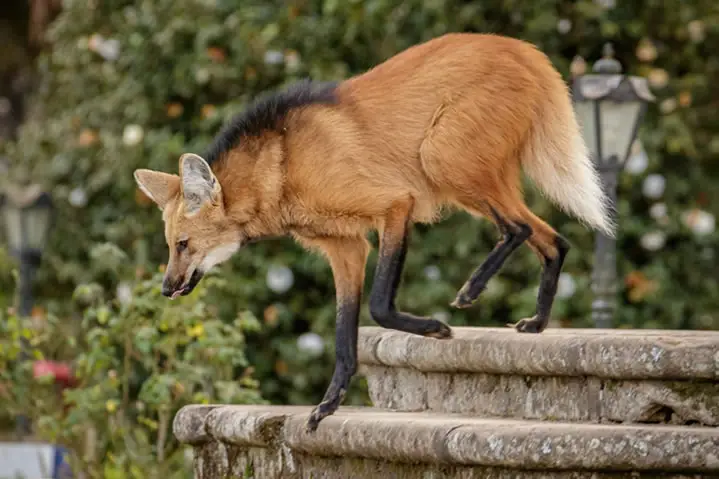
The Maned Wolf (Chrysocyon brachyurus) is one of the most iconic animals of the Brazilian Cerrado and a true natural highlight of Serra do Caraça. With its reddish coat and elegant posture, it captures the attention of visitors and researchers alike, especially during the quiet nights of the mountain range. Its name, derived from the Tupi-Guarani language, means “red,” a direct reference to the striking color of its fur, which glows under the moonlight across the Caraça grasslands.
Recognized as the largest canid in South America, the Maned Wolf has impressive proportions. Its long legs allow it to move gracefully through tall grasses and shrubs, perfectly adapted to the terrain and vegetation of the Cerrado. This body structure also helps the animal see above the vegetation and travel long distances in search of food and shelter.
The species also displays unique characteristics, such as large, constantly alert ears that move independently, functioning like natural radar systems. The combination of reddish, black, and white tones in its coat makes the Maned Wolf one of the most striking representatives of Brazilian wildlife.
Beyond its physical presence, the Maned Wolf plays a vital ecological role. It helps disperse seeds and control populations of small animals, contributing directly to the balance of the local ecosystem. Its presence in Serra do Caraça serves as a living reminder of the importance of harmonious coexistence between people and nature.
Distribution, habitat, and behavior
The Maned Wolf is a distinctly South American species, found in regions ranging from southern Amazonia to northern Uruguay. Despite its wide geographic distribution, it prefers open landscapes with low vegetation and the typical climate of the Cerrado. For this reason, Serra do Caraça—featuring extensive grassland areas and a natural transition between the Cerrado and the Atlantic Forest—provides an ideal refuge for the species.
In the region, it is common to find Maned Wolf tracks along trails leading to places such as Cascatinha, Bocaina, and Tanque Grande. These footprints are unmistakable, with four well-defined toes and visible claws. During the day, the Maned Wolf usually rests in grassy areas, frequently changing locations to avoid predators and keep its territory undisturbed.
Unlike European or North American wolves that live in packs, the Maned Wolf is solitary and territorial. Each breeding pair occupies a vast area—sometimes reaching up to 2,500 hectares—and marks its territory with urine and feces, a natural form of communication between individuals.
With nocturnal and crepuscular habits, the Maned Wolf can travel up to 30 kilometers (about 18 miles) per night in search of food. Although generally silent, it does not howl like gray wolves. Instead, it produces short barks and low sounds used to deter intruders or communicate with its partner.
Diet and ecological importance
The Maned Wolf is omnivorous, meaning its diet is highly varied. It feeds on small mammals, birds, reptiles, and amphibians, but it also consumes a large quantity of fruits—especially the well-known lobeira, often called the “wolf’s fruit.” This fruit plays a crucial role in the animal’s nutrition and environmental balance, as the Maned Wolf disperses its seeds over long distances, supporting the regeneration of native vegetation.
In addition to lobeira, the Maned Wolf eats fruits such as guava, passion fruit, and peach, as well as insects and small rodents. This diverse feeding behavior makes it a key species for maintaining the Cerrado ecosystem. It helps control pest populations while simultaneously contributing to plant propagation.
In the Caraça environment, it is not uncommon to observe the Maned Wolf investigating soil or trash bins in search of strong scents—not due to dependence on humans, but rather curiosity and instinct. Even when it receives food provided by conservation staff, the animal continues to hunt naturally, demonstrating that human interaction has not compromised its wild behavior.
Thanks to this balanced relationship, visitors can observe the Maned Wolf up close without interfering with its habits, making the encounter a unique example of responsible ecotourism.
Reproduction and life cycle
Maned Wolf reproduction typically occurs between late summer and early fall, usually from April to May. The species is monogamous, and the pair remains together throughout the breeding process and the care of the young. Gestation lasts about 65 days, and the pups are born between June and July, when temperatures are milder.
Each litter usually consists of one to three pups, born with dark fur and closed eyes. To protect them from predators, parents often choose discreet locations such as abandoned termite mounds or natural ground cavities. During the first months, the parents regurgitate food for the pups, demonstrating remarkable dedication in caring for their offspring.
At around six months of age, young wolves begin accompanying their mother on short nighttime outings, learning how to hunt and explore the territory. By the time they reach one year of age, they become independent and start seeking new areas, following the territorial instinct characteristic of the species.
In the wild, the Maned Wolf can live up to 16 years—a notable lifespan for a wild animal. This longevity reflects both the species’ adaptability and the ongoing conservation efforts in protected areas such as Serra do Caraça.
The famous “Wolf Hour” in Serra do Caraça
One of the most anticipated moments for visitors to the Caraça Sanctuary is the traditional Wolf Hour, a natural spectacle that has taken place for more than 40 years. Every evening, around 7:30 p.m., a tray with meat and fruits is placed in front of the Church of Our Lady, Mother of Humankind. Shortly afterward, the silence is broken by the majestic arrival of the Maned Wolf, which calmly climbs the steps and feeds under the attentive gaze of tourists and researchers.
This tradition began in the 1980s, when the first wolves appeared attracted by food remnants in the sanctuary’s trash bins. The practice was later maintained in a controlled manner and became a milestone in environmental education and species preservation. Today, the ritual stands as one of the most successful examples of coexistence between humans and wildlife in a protected area.
The moment is unpredictable—the Maned Wolf does not follow a strict schedule—and this uncertainty is part of the experience. While waiting for its appearance, visitors learn about the animal’s behavior, ecological importance, and the conservation actions that help ensure its survival in the region.
The Wolf Hour is far more than a tourist attraction; it is a symbol of respect and harmony with nature and an invitation to reflect on humanity’s responsibility in wildlife conservation.
Preservation and future challenges
Serra do Caraça hosts an important conservation initiative known as “Maned Wolf observation tourism as a conservation tool,” which combines scientific research, environmental education, and sustainable ecotourism. Animal monitoring is carried out using GPS collars and camera traps, allowing researchers to study behavior and movement without interfering with the wolves’ natural routines.
These efforts are essential in light of the threats the species faces. Mining expansion, the spread of monoculture farming, and roadkill on nearby highways pose real risks to Maned Wolf populations. Additionally, diseases such as mange and distemper—transmitted by domestic dogs—represent a constant danger.
Maintaining connectivity between natural areas, such as Serra do Caraça and Gandarela National Park, is crucial to ensure safe ecological corridors that allow animals to move freely and preserve genetic diversity.
The conservation of the Maned Wolf depends on joint efforts from researchers, local communities, and visitors. Every conscious action—from avoiding litter on trails to supporting environmental projects—helps ensure that this symbol of the Cerrado continues to enchant future generations in Serra do Caraça.
Conclusion: the living symbol of Serra do Caraça
Observing a Maned Wolf in Serra do Caraça is an experience that blends emotion, respect, and learning. It is the true guardian of the Caraça landscape, representing the balance between faith, nature, and history that defines the region.
More than just a wild animal, the Maned Wolf is a symbol of resilience in the Cerrado—a reminder that wildlife can coexist with humans when awareness and environmental protection prevail.
Visiting the sanctuary and witnessing the Wolf Hour means experiencing one of the most remarkable encounters between people and nature—a unique spectacle that only Serra do Caraça can offer.